What Affects the Resale Value of a Pre-Owned Luxury Watch
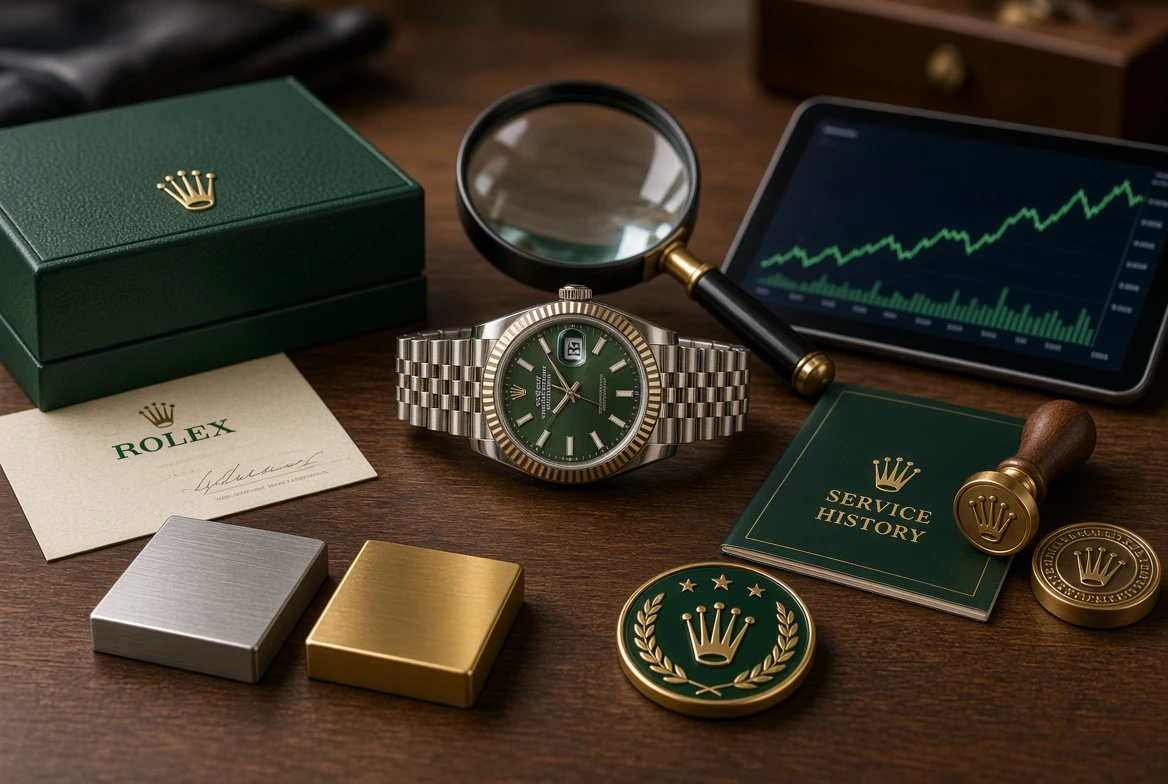
Take two watches of the same reference and similar age. One can sell for noticeably more than the other.
The difference usually comes down to three things: whether the watch has its original box and papers, the condition of the case, and demand for that particular reference. Understanding these factors makes it easier to judge whether a watch is fairly priced, whether you are buying or selling.
Box and Papers
A full set usually includes the original box, warranty card, and other documents supplied with the watch. On the secondary market, a complete example will often command more than the same watch sold without them.
The difference can be significant on collectible or high-value references. A modern Patek Philippe Nautilus with its original box and papers, for example, will generally be more desirable than an otherwise comparable watch without them.
The warranty card is particularly useful because it connects the watch to its original sale and provides a date. This matters with modern Rolex watches. Around 2010, Rolex moved to randomized serial numbers, which means the serial number alone can no longer be used to establish an exact production year.
Without the original papers, some of that history is lost. Buyers tend to price that uncertainty accordingly.
Of course, having papers is only valuable if they belong to the watch. Serial and reference details should always be checked rather than assuming that a box and warranty card automatically make a watch a full set.
Case Condition: Original Beats Perfect
A freshly polished watch may look better in photographs, but that does not necessarily make it more valuable.
Polishing removes a small amount of metal from the case. Done well and only occasionally, the effect may be minimal. Repeated or aggressive polishing can soften edges, round the lugs, and alter the original proportions of the case.
For collectors, particularly in the vintage market, those details matter.
An unpolished watch with honest signs of wear can therefore be more desirable than a spotless example that has lost some of its original case geometry. The goal is not always to find the watch with the fewest scratches. It is to find the best-preserved example.
This distinction becomes increasingly important with rare and collectible references, where originality can have a substantial effect on value.
Brand, Reference and Demand
Condition matters, but the market ultimately decides what a particular watch is worth.
Demand varies enormously between brands, models and even individual references. Production numbers, availability from authorized retailers, discontinued models and changing collector tastes can all influence secondary-market prices.
This is why there is no useful rule saying that a luxury watch should retain a certain percentage of its retail price.
A steel sports Rolex or Patek Philippe can behave very differently from a precious-metal dress watch made by the same brand. Even two references from the same collection can have very different resale values.
The best way to estimate current value is to look at recent market prices for the exact reference in comparable condition and configuration. Brand reputation alone is not enough.
What to Check Before Paying a Premium
If one watch is priced above another, find out what you are actually paying for.
- Box and papers: Are they original to the watch, and do the identifying details match?
- Case condition: Has the watch been polished? If so, is the original shape and definition of the case still well preserved?
- Configuration: Are the dial, hands, bezel, bracelet, and other important components correct for the reference and period?
- Market demand: Is the premium supported by the current market for that exact reference, rather than simply by the brand name?
At WATCHOYSTER, each listing describes the condition of the watch, whether the original box and papers are included, and other relevant details about the piece.
Before being offered for sale, every watch is physically inspected by an experienced watchmaker and its serial number is checked against The Watch Register.
In Short
The resale value of a pre-owned luxury watch comes down to more than the name on the dial.
Original box and papers can add value. A well-preserved case can matter more than a freshly polished one. Most importantly, demand for the exact reference determines what buyers are prepared to pay
When comparing two apparently similar watches, look beyond the headline price. Check the completeness, originality and condition of each example, then compare it with the current market for that specific reference.
Every watch sold by WATCHOYSTER comes with a 12-month warranty and is covered by the applicable return policy.
Jack Cooper

Jack is the son of blog owner Samantha. He is a student with a love of all things technology. Jack loves hanging out with his corgi named Junior, the Dallas Cowboys, UVA sports, playing video games and being outdoors. He also loves cooking, but dishes not so much.

Jack Cooper
Jack is the son of blog owner Samantha. He is a student with a love of all things technology. Jack loves hanging out with his corgi named Junior, the Dallas Cowboys, UVA sports, playing video games and being outdoors. He also loves cooking, but dishes not so much.


You May Also Like

5 Tips To Ensure Quality Concrete Acid Staining

Aquaponics For Your Tiny Home

